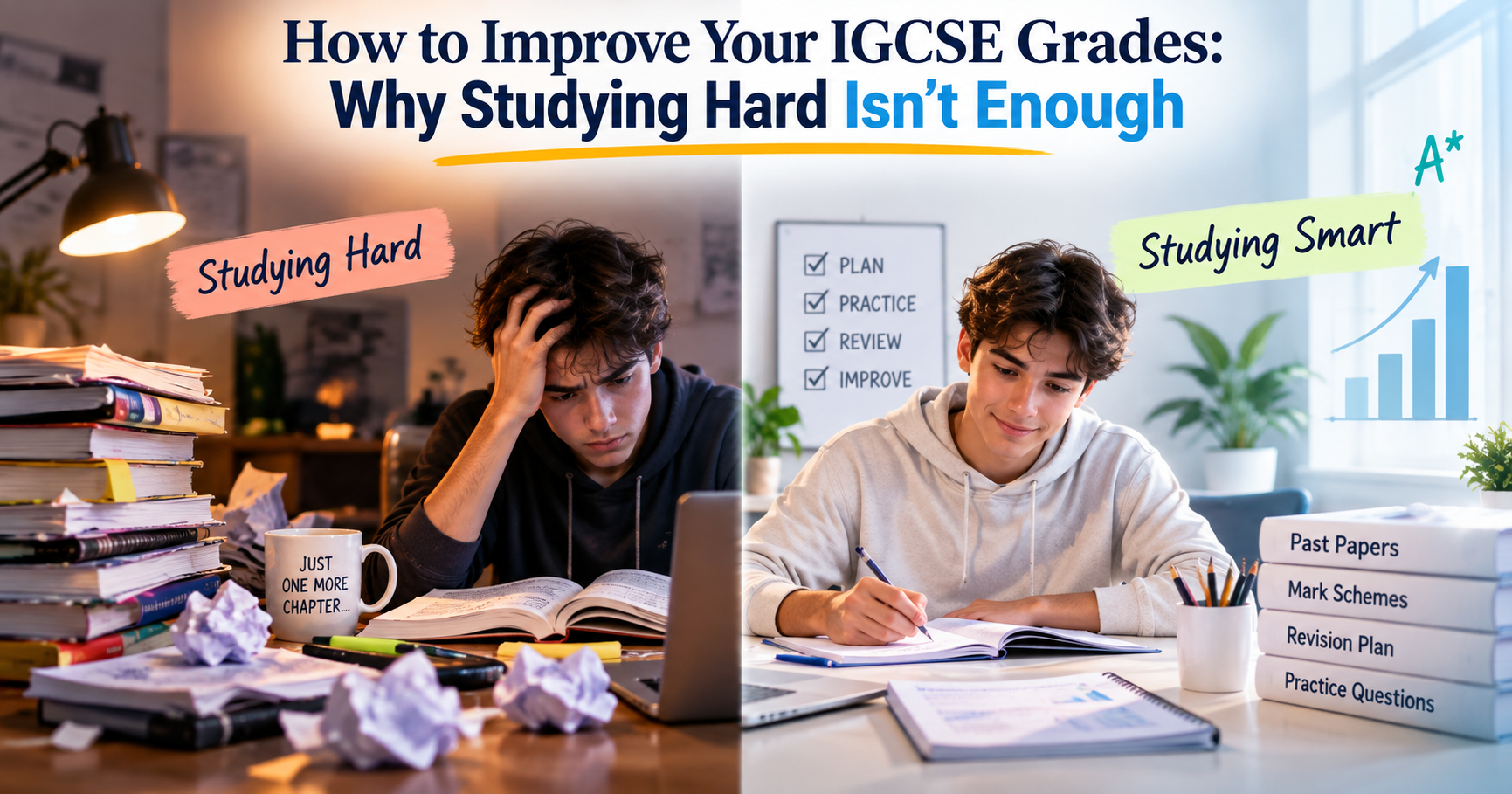

If you’re studying for your IGCSE exams but your grades still aren’t improving, the problem may not be how much you study, but how you study. Effective IGCSE revision requires a combination of understanding, past-paper practice, exam technique and consistent review.
I have lost count of how many times I have heard this line from a student:
“I studied every night, I did all the notes… but my grade still dropped.”
It is such a crushing feeling. You put in the hours, you sacrifice sleep, you walk into the exam hall convinced you have done everything right, and then you walk out with a result that does not reflect the effort.
That was exactly what happened to Maya, one of my students at GTG. She was not lazy. She was not careless. In fact, she was one of the most disciplined learners I had ever taught. But despite all the late nights and endless revision, her marks kept hovering below her expectations.
The problem was not her work ethic. It was her strategy. Because in IGCSE exams, effort alone does not guarantee success. What matters is how you channel that effort into practice, confidence, and the right approach to turn knowledge into marks.
Why Studying Hard Doesn’t Always Improve Your IGCSE Grades
Maya’s routine was intense. She would rewrite notes, memorise definitions, and drill formulas for hours every evening. On paper, it looked like she was doing everything right.
But when exam season came, her grades did not match the grind. She would walk out of school exams with C’s and D’s, while classmates who seemed to study less were pulling in A’s.
“It felt so unfair,” Maya told me once. “I was putting in more effort than anyone else, but I was the one walking away with the lowest marks.”
It was not that she did not know the material. She could recite definitions word for word. She could list formulas from memory. But when faced with actual exam questions, she froze. The questions felt unfamiliar, the wording threw her off, and the pressure of timed conditions made her second‑guess herself.
This is the trap so many students fall into. They mistake studying hard for studying effectively. And the truth is, exams do not reward effort. They reward application.
3 Common IGCSE Study Mistakes That Keep Students Stuck
There are three main reasons why students like Maya under-perform, even when they are working hard.
Practice matters just as much as knowledge.
You can memorise every formula in the syllabus, but if you do not practice applying them under exam conditions, you will freeze when the paper lands on your desk. Knowledge without practice is like learning to swim by reading a book. You will sink the moment you hit the water.
School exams versus Cambridge thresholds.
Most schools deliberately set tougher papers than Cambridge. They want students to be prepared for the worst. That means under performing in school exams does not mean you are doomed. It means you need to adjust your strategy. Many students panic when they see a D or E in a school test, not realising that Cambridge thresholds are often more forgiving.
Confidence comes from familiarity.
Many students lose marks not because they do not know the content, but because they panic in the exam hall. The cure is practice. The more past papers you do, the calmer you will be when it counts. Confidence is not built by memorising notes. It is built by facing the same style of questions over and over until they feel routine.
How to Study Effectively for IGCSE Exams
So how do you fix this? How do you turn effort into results?
Here is the system I recommend, and the one that helped Maya turn things around:
Build a timetable: Balance revision with practice. For example, spend 30 minutes reviewing notes, then tackle one past paper question. Over time, increase the number of questions until practice becomes the bulk of your routine.
Aim for consistency, not burnout: Medium effort every day beats exhausting marathons. Maya used to study in long, draining sessions that left her exhausted. Once she switched to shorter, consistent blocks, she retained more and felt less overwhelmed.
Use the right materials: Past papers, mark schemes, and topical practice are your best friends. Notes are useful, but they are not the finish line. The finish line is being able to answer questions the way examiners expect.
Track your progress: Do not just do papers blindly. Mark them, compare with the scheme, and set small weekly goals. For example, “This week, I will master collision theory questions.” Next week, “I will nail stoichiometry.”
The GTG IGCSE Practice Cycle
In GTG we follow a simple learning cycle:
1. Learn -> 2. Practice -> 3. Mark ->
4. Classify the mistake -> 5. Retry -> 6. Revisit one week later.
The most important step is often Step 4.
When you make a mistake, do not simply correct the answer and move on. Ask yourself why you lost the mark.
Was it a:
- Knowledge gap — I did not know the concept.
- Method error — I knew the topic but used the wrong approach.
- Misread question — I misunderstood what the examiner was asking.
- Careless error — I knew what to do but made an arithmetic, sign or copying mistake.
- Exam-technique error — My answer did not contain the working, keyword or justification required.
- Time-pressure error — I could answer it, but not quickly enough under examination conditions.
Once you know the type of mistake, fixing it becomes much easier.
Doing five papers while carefully analysing every mistake can be far more valuable than completing ten papers and repeatedly making the same errors.
GTG applies a structured, repeatable process consistently.
A Simple IGCSE Revision Routine to Try This Week
You do not need to completely change your study routine overnight.
Start small.
Spend part of your revision time reviewing the concept, then spend the majority applying it to questions. Mark your work carefully and record the questions you got wrong.
A simple session might look like this:
20 minutes: Review the topic and key concepts
40 minutes: Complete topical or past-paper questions
15 minutes: Mark your answers using the mark scheme
10 minutes: Record and classify your mistakes
5 minutes: Retry one or two questions without looking at the solution
Then revisit those mistakes several days later.
The goal is not simply to finish more questions. The goal is to make sure that the same mistakes become less frequent each time you practice.
How Maya Flipped the Script
When Maya first came to me, she was stuck at a C in Chemistry and a D in Maths. She was frustrated because she felt she was working harder than everyone else.
We restructured her routine. Instead of spending three hours rewriting notes, she spent one hour reviewing fundamentals and two hours practising past paper questions. She started small, just one topical paper per week.
At first, she struggled. She would get half the answers wrong, and the mark scheme felt like a foreign language. But slowly, she began to see patterns. She realised examiners were not looking for long essays. They wanted keywords, formulas, and concise steps.
Her confidence grew. By the time she sat her next school exam, she was not panicking anymore. She knew how to spot command words, underline key information, and justify each step of her working.
Within six months, Maya went from a C/D student to consistently scoring B’s and A’s. And when the final Cambridge exams came, she walked away with an A in Chemistry and an A* in Maths.
“I used to think rewriting notes was enough,” she told me later. “But once I started practising past papers, everything changed. I could finally see how the examiners wanted me to answer.”
Lessons From Maya’s Journey
What struck me most about Maya’s transformation was not just the improvement in her grades. It was the change in her mindset.
She stopped equating effort with success. She realised that studying smart was more important than studying endlessly. She learned to trust the process, to focus on practice, and to build confidence through repetition.
And perhaps most importantly, she discovered that exams are not about proving talent. They are about demonstrating preparation.
Her story is proof that anyone can improve. You do not need to be naturally gifted. You do not need to be the smartest in the room. You just need the right strategy, the right practice, and the right mindset.
The Takeaway
Studying hard is not enough. You need strategy, practice, and consistency.
Schools will always set tough papers. Exams will always feel intimidating. But if you build a routine that balances knowledge with practice, you will stop under performing and start outperforming.
Maya’s story is not unique. I have seen it happen again and again. And if you are reading this, it can happen for you too.
Stop cramming. Start practising. That is how you turn effort into results.
Disclaimer:
Student’s name has been changed for privacy.
Article written by Teacher Mark
Teacher Mark teaches Maths and Science for lower secondary students and Chemistry for students preparing for Cambridge IGCSE examination in GTG IGCSE Tuition Centre – Sri Rampai branch.
FAQ
How many IGCSE past papers should I do?
Quality matters more than simply counting papers. Complete enough papers to experience different question styles, but spend time analysing and retrying every important mistake.
When should I start practising IGCSE past papers?
Start with topical questions once you understand a chapter. Full timed papers become more useful once most of the syllabus has been covered.
Should I revise my notes or do past papers?
Both have a role, but as the examination approaches, application should take up more of your revision time. Use notes to fix gaps discovered while doing questions.
Why can I answer questions in class but struggle during exams?
Classroom understanding and examination application are different skills. Timed practice, unfamiliar questions and repeated exposure to exam wording help bridge that gap.
Sign up for a free trial class today