How Zachary Beat The Odds
(and the “Talented” Kids)
Updated on July, 2026
Every year, I meet students who tell me the exact same thing: “Mr. Gilbert, I’m just not a math person.” They look at their classmates who score effortless A*s in IGCSE Maths and assume those kids possess are just naturally talented.
But true success in the Cambridge IGCSE syllabus isn’t about natural talent. It’s about strategy, mindset, and sheer, consistent work.
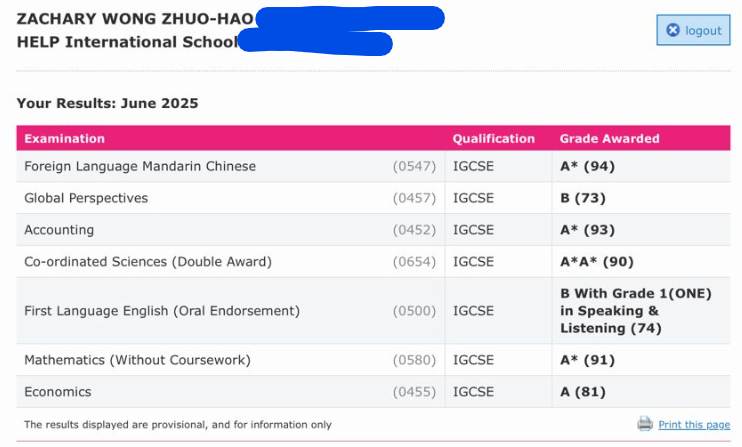
Today, I’m sitting down with Zachary, a former student of mine here at GTG IGCSE Tuition Centre. Zachary’s story is legendary around here. In Year 9, Zachary was placed into the “Core” math track—failing his continuous assessments with D’s and E’s. Yet, by the time he sat for his final Cambridge papers, he didn’t just pass Extended Math; he completely conquered it with an A*s.
I wanted to chat with him to unpack exactly how he flipped the script, the exact routines he changed, and how he ended up outscoring the very classmates who used to laugh at his grades.
TLDR:
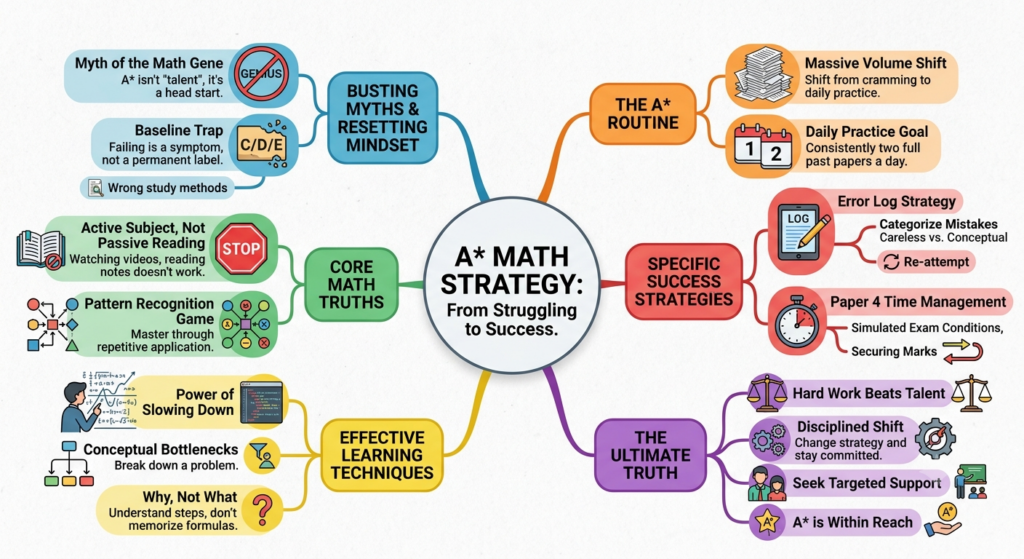
- The Baseline Trap: Being placed in a lower track (like IGCSE Core) or getting failing grades (like D’s and E’s) isn’t a permanent label—it’s just a symptom of using the wrong study method.
- The Math Gene is a Myth: The “talented” students scoring effortless A*s usually just have a massive head start through years of early practice and intensive tuition.
- Math is Not a Reading Subject: Trying to study math by reading notes, watching videos, or memorizing formulas doesn’t work. Math is a pattern-recognition game that can only be mastered through active, repetitive application.
- The Power of Slowing Down: Overcoming a conceptual bottleneck requires breaking questions down line-by-line to understand why a step is taken, rather than rushing to memorize a formula for the answer.
- The A* Routine: Flipping a failing grade into a top mark takes a massive shift in volume—moving from cramming a day or two before an exam to consistently practicing two full past papers a day.
- The Error Log Strategy: True improvement comes from keeping a strict log of wrong answers, categorizing why the mark was lost (careless mistake vs. conceptual error), and forcing yourself to re-attempt the exact same problem a few days later.
- Paper 4 Time Management: Train under strict simulated exam conditions. If you hit a wall on a high-mark question, move on immediately to secure the available marks, then loop back to the difficult problems with a calm mind.
- The Ultimate Truth: Hard work beats talent when talent doesn’t work hard. By shifting your strategy, staying disciplined, and seeking targeted support, an A* is entirely within reach.
Feeling Completely Lost at The Beginning
Gilbert: Take us back to the beginning, Zach. How did you honestly feel about IGCSE math when you were struggling, and what was your lowest point?
Zachary: Honestly, at the beginning, I felt completely lost. Math was something I really disliked because it required so much time and practice. I was constantly getting C’s and D’s, and if I’m being honest, I was comfortable cruising at a C. I didn’t see the need to improve.
But then came the wake-up call. We had a school test where I completely tanked—I got an E. Everyone else around me got at least a C. I felt so embarrassed. Finals were getting closer, my marks weren’t improving, and I was stuck in the Core class. That was the moment I realized, “Okay, I need to lock in.”
Gilbert: It’s crazy looking back, because by the end of our sessions in Year 11, I was completely certain you were going to score an A or an A*s. But before you came to the center, you actually tried a few different private tutors, right?
Zachary: Yeah, I had a couple! In Year 9, I had an online tutor for about six months. But I used to do my home workouts right before class, so I’d show up all sweaty, exhausted, and barely paying attention. Then I had another tutor on Saturday mornings, but it felt so boring. I just didn’t do the work. I was way more focused on sports back then—competitive swimming and football—so academics took a backseat until things got serious.
The Myth of the “Math Person”
Gilbert: A lot of kids feel like they just don’t have the “math gene.” Did you look at your classmates who were scoring A*s and feel like they had a secret talent you lacked?
Zachary: Absolutely. I had a friend in the Extended class who was constantly getting A*s. I genuinely thought he was just naturally a genius who never had to practice. Whenever I told him I got a C in Core, he’d laugh at me.
But later on I found out that it wasn’t a secret talent at all. He had been going to intensive tuition since he was very young and had piled up years of practice beforehand. He just had a head start.
IGCSE Mathematics is not Meant for Memorization
Gilbert: When you were struggling early on, how were you trying to study? Looking back, why wasn’t that method working?
Zachary: Before I joined GTG, I studied for math the way I studied for heavy reading subjects—memorizing formulas, reading through textbook notes, and watching random math videos. When I did attempt questions, I didn’t actually analyze my mistakes.
Now I know that’s completely ineffective. Math isn’t a memorization game; it’s a pattern-recognition game. Because I wasn’t practicing constantly and reviewing my errors, I couldn’t see the structural patterns Cambridge uses in their exam papers.
Gilbert: You hit the nail on the head. So, what was the single biggest bottleneck for you back then? Was it the concepts, exam anxiety, or time management?
Zachary: It was application. I would sit in school, listen to the teacher, and think I understood the topic. But the moment a blank exam paper was in front of me, I’d freeze. On Paper 4, I used to waste minutes just staring at a question, thinking and thinking, instead of just putting pen to paper. My mental math was also terrible back then—I joke that I was using my fingers and toes!
Gilbert: (Laughs) I remember that! It used to drive me crazy watching you overthink it. I’d be shouting, “Let’s go, let’s just attempt it!”
Breaking the IGCSE Cambridge Exam Code
Gilbert: How did your perception of the IGCSE math syllabus change once we started breaking down how the questions are actually structured?
Zachary: It shifted everything. Once we started pulling the questions apart at the center, I realized the syllabus wasn’t this impossible mountain. Cambridge questions follow a common pattern and style. They test the exact same core skills year after year; they just wrap them in different phrasing.
Eventually, after doing enough targeted practice, it became repetitive. I got to a point where I could read the first line of a question and immediately predict the exact formula needed. The whole structure of the exam paper was mapped out at the back of my mind.
Gilbert: Exactly! You unlocked the ultimate exam technique. Once you understand how to take an exam, that skill applies to everything.
Zachary: Definitely. Honestly, now that I’m doing my A-Levels, math has actually become my “relax/chill” subject. When I’m stressed out by Economics or Business studies, I do math for fun because it’s just about solving the puzzle.
The Turning Point: Concept Over Formula
Gilbert: Can you remember the very first topic we tackled together where the light bulb finally went on?
Zachary: It was algebra. It’s embarrassing to admit, but back then, I couldn’t even do basic algebraic expansions. The moment a question had multiple steps, my brain would short-circuit.
What made the difference at the center was that we didn’t just rush to memorize the formula to get the answer. We slowed down. We broke down every single line, focusing on why we were taking that step. Once I understood the logic behind moving a variable, my confidence shot up, and suddenly the long, intimidating questions didn’t scare me anymore.
Gilbert: Moving from a fail to an A* requires a total lifestyle shift. What did your routine look like before versus during exam season?
Zachary: Before, my “strategy” was cramming one or two days before a school test. Leading up to the actual IGCSEs, though, I was doing at least two full past papers every single day. I had a strict study schedule. I focused heavily on my weak topics, highlighted my errors, and repeated the hardest questions over and over until I could solve them flawlessly without looking at the mark scheme.
The Strategy for Mistakes & Managing Paper 4
Gilbert: Paper 4 can be absolutely brutal—11 to 12 long, structured, high-mark questions. How did you train yourself to handle that time pressure without panicking?
Zachary: I would usually attempt Paper 4 under timed conditions, so I could get used to the feeling of it in a real exam. At first, I was way too slow. But after grinding through enough papers, I could understand how much time I should spend on a question
My golden rule became: If you get stuck, move on immediately. I would finish the whole paper, secure the other marks first, then go back to the question I was stuck on, and work on that one.
Gilbert: Whenever you hit a wall with a particularly nasty Algebra or Trigonometry question outside of class hours, how did you get the support you needed to keep going?
Zachary: I’m also a bit of a late sleeper, so whenever I ran into a question that I couldn’t solve on my own, I would usually snap a picture and send it to you, not really expecting an answer until the next day. But I was so surprised when I sent a question close to midnight and still got an instant reply from you!
Gilbert: (Laughs) Hey, when my students are locked in and working hard, I’m locked in too! If you’re willing to put in the hours, I’m always going to be there to clear the roadblocks for you, no matter the time.
The Payoff:
Hard Work Beats Talent
Gilbert: Describe the moment you opened your official Cambridge results and saw that A*. Who was the first person you told?
Zachary: I was in total shock. It felt completely unreal because a couple of years prior, I was a Core student who thought an A* was a pipe dream. My mom and dad were standing right next to me, so they were the first to know. They were incredibly proud—and honestly, a bit shocked too!
Then, of course, I texted you straight away. I’m not going to lie, I definitely thought about posting it on my social media story too, just because of everyone who had doubted me. I ended up scoring higher than some of the kids who used to laugh at my grades.
Gilbert: It’s the classic story of talent versus hard work. I see it all the time. The naturally “talented” kids get complacent and coast, while the ones who put in the grit blow right past them.
Zachary: Exactly. There’s that great quote I actually used for my IGCSE English speech: “Hard work beats talent when talent doesn’t work hard.”
Zachary’s 3 Steps to Turn Your IGCSE Grades Around Today
Gilbert: If a student is reading this right now, failing their math tests and feeling completely overwhelmed, what are the first three actionable steps they should take today?
Zachary:
- Target your bottlenecks: Stop trying to revise everything at once. Pinpoint the exact topics that you are weak at and tackle them first.
- Start past papers early: Don’t wait until you’ve finished the syllabus. Get into the past papers immediately so you can learn the Cambridge format and question patterns.
- Drop your ego and ask for help: If you’re shy, force yourself out of your comfort zone. Ask your peers, or find a tutor who can give you targeted, one-on-one breakdowns.
A new perspective can make a concept click in five minutes what might take you five hours to figure out alone.
Even if you are failing right now, your current grades are not permanent. Change the way you study, stay consistent, and you can absolutely turn it around.
Looking Back: Advice to My Past Self
Gilbert: If you could go back in time to talk to yourself when you were failing, stressed out, and stuck in Core math, what would you tell that student?
Zachary: I would tell myself that failing math is not the end of the world. It doesn’t mean you’re inherently bad at the subject; it just means you’re studying the wrong way or missing the pattern of the questions. All you need to do is change your strategy and increase your targeted practice questions.
I would also tell myself to stop comparing myself to those “smart” people who had a head start. Just focus on your own lane and look at how you can improve step-by-step.
As a proud Catholic, a massive part of my journey was also shifting my spiritual mindset. I would tell myself: put in the hard work, trust the process completely, and let God take care of the rest. I prayed every single day during exam season. When you know you’ve done your absolute best and given it everything you’ve got, you can find peace leaving the final results in His hands.
Gilbert: That is beautiful, Zach. Honestly, “trust the process and let God take care of the rest” is a philosophy that extends way beyond exams. When you pair relentless, unshakeable hard work with faith, the breakthrough is inevitable.
Sign up for a free trial class today